

Please enter your Email Address below to be sent an email to Reset your Password
Please enter your Email Address below to be sent an email to Reset your Password
Categories
Filter Products
No Filters Available
Your Basket
Your Basket is Empty

Search our Website:

Free Next Day Delivery
on orders over £100 before 2PM

Over 5000+ Products
in our stock range

Family Owned Business
established 10+ years

Discounts Available
on 100's of products
Posted: 07 October 2026
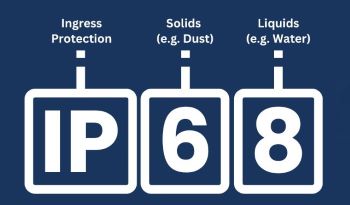
An IP rating, or Ingress Protection rating, indicates the level of protection an electrical enclosure or product provides against the entry of solid objects, dust and water.
IP ratings are particularly important when choosing electrical products such as lighting, switches, sockets, junction boxes, enclosures, outdoor electrical equipment and bathroom fittings, where the product may be exposed to dust, moisture or water.
An IP rating normally consists of the letters IP followed by two numbers, for example:
IP65
Each number has a different meaning:
IP 6 5
6 = protection against solid objects and dust
5 = protection against water
The higher the number, the greater the specified level of protection — but the two digits should always be considered separately.
| First Digit | Level of Protection | What It Means |
|---|---|---|
| 0 | No protection | No specific protection against contact or solid objects. |
| 1 | Objects ≥ 50mm | Protected against large solid objects and access with the back of a hand. |
| 2 | Objects ≥ 12.5mm | Protected against finger-sized objects and similar intrusion. |
| 3 | Objects ≥ 2.5mm | Protected against objects such as tools and thick wires. |
| 4 | Objects ≥ 1mm | Protected against most wires, screws and small solid objects of 1mm or greater. |
| 5 | Dust protected | Dust may enter in limited quantities, but not enough to interfere with satisfactory operation. |
| 6 | Dust-tight | Complete protection against the ingress of dust. |
IP0X → no specified solid protection
IP4X → protected against objects 1mm and larger
IP5X → dust protected
IP6X → dust-tight
| Second Digit | Level of Protection | What It Means |
|---|---|---|
| 0 | No protection | No specific protection against water. |
| 1 | Dripping water | Protected against vertically falling water drops. |
| 2 | Dripping water when tilted | Protected against vertically falling drops when the enclosure is tilted up to 15°. |
| 3 | Spraying water | Protected against water spraying at angles up to 60° from vertical. |
| 4 | Splashing water | Protected against water splashing from any direction. |
| 5 | Water jets | Protected against water jets from any direction. |
| 6 | Powerful water jets | Protected against powerful water jets. |
| 7 | Temporary immersion | Protected against the effects of temporary immersion in water under specified test conditions. |
| 8 | Continuous immersion | Protected against continuous immersion under conditions specified by the manufacturer. |
| 9 | High-pressure/high-temperature jets | Protected against close-range, high-pressure and high-temperature water jets under the applicable test conditions. |
IPX0 → no specified water protection
IPX4 → splash resistant
IPX5 → protected against water jets
IPX6 → protected against powerful water jets
IPX7 → protected against temporary immersion
IPX8 → protected for continuous immersion under specified conditions
| IP Rating | Solids Protection | Water Protection | Typical Applications |
|---|---|---|---|
| IP20 | Objects ≥ 12.5mm | None | Many indoor electrical products in dry locations |
| IP44 | Objects ≥ 1mm | Splashing water | Suitable for many products requiring splash protection |
| IP54 | Dust protected | Splashing water | Equipment requiring improved dust and moisture protection |
| IP55 | Dust protected | Water jets | Equipment exposed to dust and water jets |
| IP65 | Dust-tight | Water jets | Common for outdoor electrical equipment and lighting |
| IP66 | Dust-tight | Powerful water jets | More demanding outdoor and industrial environments |
| IP67 | Dust-tight | Temporary immersion | Equipment requiring dust-tight construction and temporary immersion protection |
| IP68 | Dust-tight | Continuous immersion | Equipment designed for immersion under manufacturer-specified conditions |
Take a product rated IP65.
The first digit is 6, which means the enclosure is dust-tight.
The second digit is 5, meaning it is protected against water jets.
An IP65 product therefore offers a high degree of protection against both dust and water ingress and is commonly used for suitably designed outdoor electrical products.
However, IP65 does not mean waterproof in every situation. It does not automatically mean that a product can be submerged in water.
Not necessarily.
The correct IP rating depends on where and how the product will be installed.
For example, a standard indoor accessory may not need the same ingress protection as an outdoor light exposed to rain. Likewise, a product that could be temporarily submerged requires a different level of protection from one that only needs to withstand splashing water.
The aim is therefore not simply to choose the highest IP rating available, but to choose a product with an appropriate rating for the intended environment and installation.
The term waterproof can be misleading.
An IP rating tells you the specific level of water-ingress protection for which the enclosure has been classified. For example, IP44, IP65 and IP67 represent very different levels of water protection.
A product rated IP65 may withstand water jets but is not thereby rated for immersion. Conversely, an IP67 product has been classified for temporary immersion under specified test conditions.
Always check the manufacturer's installation instructions and product specification before installing electrical equipment in wet or demanding environments.
You may occasionally see ratings such as IPX4 or IP6X.
An X means that a numerical protection rating has not been specified for that part of the IP code.
For example:
IPX4 – water protection is rated at level 4, while a numerical solid-ingress rating is not specified in that designation.
IP6X – solid-ingress protection is rated at level 6 (dust-tight), while a numerical water-ingress rating is not specified in that designation.
An X should not be interpreted as zero.
IP ratings are particularly important when selecting electrical equipment for bathrooms and other locations containing a bath or shower.
Different bathroom zones have specific requirements, and suitability depends on more than simply the IP number. The location of the equipment, applicable wiring regulations, manufacturer's instructions and the nature of the installation must all be considered.
For this reason, an IP rating should not be used on its own to determine whether a product is suitable for a particular bathroom location.
| Rating | Simple Explanation |
|---|---|
| IP20 | Finger/object protection; no specified water protection |
| IP44 | Protected against small objects and splashing water |
| IP54 | Dust protected and protected against splashing water |
| IP55 | Dust protected and protected against water jets |
| IP65 | Dust-tight and protected against water jets |
| IP66 | Dust-tight and protected against powerful water jets |
| IP67 | Dust-tight and protected against temporary immersion |
| IP68 | Dust-tight and protected for continuous immersion under specified conditions |
When you see an IP rating, read the two numbers independently:
First number = solids and dust protection
Second number = water protection
So, for IP65:
6 = Dust-tight
5 = Protected against water jets
Understanding these two numbers makes it much easier to select electrical equipment appropriate for indoor, outdoor, dusty or wet environments.
Important: IP ratings describe an enclosure's tested degree of protection against ingress. They do not replace the need to follow the manufacturer's instructions, applicable electrical regulations or appropriate installation practices.