

Please enter your Email Address below to be sent an email to Reset your Password
Categories
Filter Products
No Filters Available
Your Basket
Your Basket is Empty

Search our Website:

Free Next Day Delivery
on orders over £100 before 2PM

Over 5000+ Products
in our stock range

Family Owned Business
established 10+ years

Discounts Available
on 100's of products
Posted: 23 November 2026
Posted: 23 November 2026
An electric fire is one of the easiest ways to add a focal point and extra warmth to a room. There’s no chimney, no fuel to store and, for many models, no installation beyond plugging in. Dimplex is one of the best-known names in electric fires, with a wide choice of stoves, inset fires, wall-mounted fires and complete fire suites. That choice is great, but it can make it hard to know where to start. This guide explains the different types, the Dimplex flame effects, and what to check before you buy. If you’d like to see the full choice first, browse our range of electric fires.
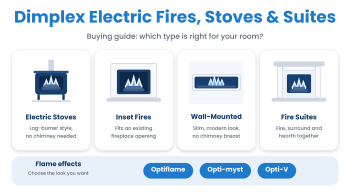
Dimplex electric fires generally fall into four styles. The right one depends on your room, whether you already have a fireplace and how much work you want to do.
| Type | What it is | Installation | Best suited to |
|---|---|---|---|
| Electric stove | A freestanding, log-burner-style fire | Usually plug-in, with no fireplace needed | Rooms with no fireplace, or a stove look on a hearth |
| Inset fire | A fire that sits inside an existing fireplace opening or a surround | Needs a suitable opening, and may need installing | Replacing an old gas or electric fire in a fireplace |
| Wall-mounted fire | A slim fire that hangs on the wall or sits in a recess | Needs fixing, and may need an electrician | Modern rooms and spaces with no chimney breast |
| Fire suite | A complete package with the fire, surround and hearth together | Needs wall space, and the setup depends on the model | Creating a full fireplace feature from scratch |
Electric stoves give you the look of a traditional log burner without the flue, fuel or installation work. They are freestanding, so they can go almost anywhere you have a socket, and they come in traditional and modern designs and a choice of colours and finishes. Many stoves have a realistic log or fuel bed and a glass front, and you can often choose a flame effect to match your budget and the look you want. A stove is a good choice if you don’t have a chimney or fireplace, or if you want to add some character to a room with a simple, plug-in solution. Take a look at the Dimplex Leckford Optiflame stove for an example.
Inset fires sit inside an existing fireplace opening or a surround, and they are a popular way to replace an old gas or electric fire. Wall-mounted fires hang on the wall or sit in a recess, and the slim, modern profile suits contemporary rooms and spaces with no chimney breast. Both types usually need more planning than a stove, so check the dimensions, the depth needed and how the fire is connected. Some models plug in, while others should be installed by a qualified electrician. See the Dimplex Balmoral Chrome Optiflame inset electric fire for an example of an inset model, or the Dimplex Opti-myst wall-mounted fire if you’d prefer a wall-mounted style.
A fire suite is the simplest way to create a complete fireplace feature, because the fire, surround and often the hearth and back panel are designed to work together. Suites come in a wide range of designs and finishes, from traditional mantels to sleek modern styles, and there are smaller suites for rooms where space is tight. Measure your wall space, including the height and width of the surround, and check how much room you need to the sides and above it. The Dimplex Chadwick Optiflame suite is a good example of a complete fireplace package.
Dimplex fires are available with three main flame effects, and the effect you choose has a big effect on both the look and the price.
It’s worth seeing each effect in action, if you can, as the difference is much easier to judge on video or in person than in a description.
Many Dimplex electric fires include a 2kW thermostatically controlled heater, and many also let you run the flame effect without the heat, so you can enjoy the look all year round. As a rough guide, many people allow around 100W of heating per square metre in a reasonably well-insulated room, so a 2kW fire suits small to medium rooms or works well as supplementary heat in a larger one. Poor insulation, draughts and high ceilings all mean you’ll need more. Check the specification of the exact model, as heat output varies.
Electric fires with a heater are covered by the same Ecodesign rules (often called Lot 20) as other electric heaters, so look for compliance information and the controls listed in the specification.
Stoves and many plug-in fires can be set up easily, but wall-mounted and Opti-V fires typically need installing, and any fixed connection should be done by a competent electrical professional. Always follow the manufacturer’s instructions on clearances, never cover a fire that’s switched on, and keep furniture, curtains and other items away from the heater. If you’re fitting a fire into an existing fireplace, check that the opening is safe and the right size first.
The right Dimplex electric fire comes down to a few choices. Decide whether you want a stove, inset fire, wall-mounted fire or complete suite. Then choose the flame effect that suits your budget and the look you want. Finally, check the size, heat output, controls and installation requirements. Take your time to measure and compare, and you’ll end up with a fire that looks great and keeps your room warm all winter. When you’re ready to compare options, browse our full range of electric fires.
Fixed electric fires should be selected, installed and tested by a competent electrical professional where required. Requirements depend on the individual installation and the applicable edition of BS 7671.